
September 2026
What happened to VPS prices in 2026, and how we are holding the line
This year server memory and drives got more expensive in a way not seen in decades, and the ones that set the market's reference price have already changed their lists. Before we tell you how we are holding the line, here is what happened, with the figures for each case.
In short
- Server memory now costs several times what it did a year ago. SSDs are on the same path.
- Server manufacturers raised their lists by 15% to 30%, AWS adjusted twice in six months and Leaseweb raised its VPS by up to 41%.
- Our list is still the one from before the increase, for as long as the capacity we already have installed lasts. If we had to adjust it, plans already paid for one, two or three years keep their price until they end.
1. Memory went to AI
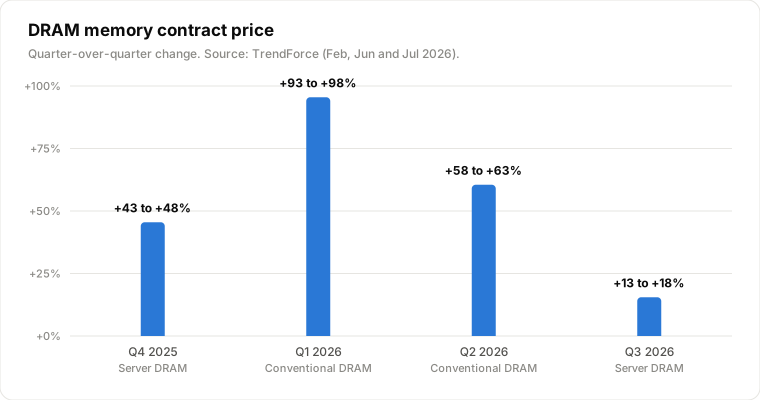
DRAM contract prices (the memory inside every server) rose quarter after quarter since late 2025, according to TrendForce, the industry's reference analyst:
| Period | Quarter-over-quarter contract price change |
|---|---|
| Q4 2025 | Server DRAM: +43% to +48% |
| Q1 2026 | Conventional DRAM: +93% to +98% (industry revenue reached US$97 billion, +81% in one quarter) |
| Q2 2026 | Conventional DRAM: +58% to +63% |
| Q3 2026 | Server DRAM: +13% to +18% |
The cause is on the supply side: Samsung, SK hynix and Micron moved production lines to HBM, the high-bandwidth memory used by AI accelerators. The large cloud providers signed multi-year agreements that fix their price and volume, so the increase lands on whoever buys without a long contract: most mid-sized providers in the world. For 2027, TrendForce expects server module supply to grow only 15% to 20%, below demand.
2. Drives are on the same path
SSDs follow the same logic, because 90% of their cost is NAND memory and NAND also went to AI data centers. Enterprise SSD contracts rose 53% to 58% in the first quarter of 2026, and NAND prices multiplied by 4 to 4.5 in nine months. Western Digital has already sold its entire 2026 output, and the next NAND fabrication capacity does not come online before late 2027.
3. What the big players did
We looked at the ones that set the market's reference price: the server manufacturers, the world's largest cloud provider and a European infrastructure operator with 25 years of history. None of them sells cheap, and all three went up.
The server manufacturers (Dell, Lenovo, HP and HPE):
- December 2025: all four announced list increases of around 15% on servers. Lenovo called it "an unprecedented cost increase widely in the industry, especially on memory and SSD, more dramatic than any player can mitigate".
- March 30, 2026: Dell raised its entire list by 17% and warned of up to 30% on memory-heavy configurations. Its quotes are now valid for fewer days than ever, according to its chief operating officer.
- In a reference 2U server with 512 GB, memory went from 18% of the cost in January 2025 to 53% in July 2026: more than half of a new server, today, is memory.
AWS (Amazon Web Services, the world's largest cloud provider):
- Raised the price of its reserved AI compute capacity (EC2 Capacity Blocks) twice in six months: around 15% in January 2026 and another 20% in July. Its explanation: prices "change periodically based on supply and demand".
- In April, AWS itself acknowledged that the server memory shortage is pushing companies to the cloud because they cannot get their own hardware.
Leaseweb (Netherlands, enterprise infrastructure since 1997):
- August 1, 2026: a new VPS list for new contracts, 7% to 41% higher depending on the region (16% in Europe, 24% in the UK, 41% in the United States). In the US, the VPS 5 went from US$36.70 to US$55.99 per month.
- Existing contracts renew at the current price until the customer changes them. Stated reasons: AI-driven memory and storage shortage, IP address shortage and inflation.
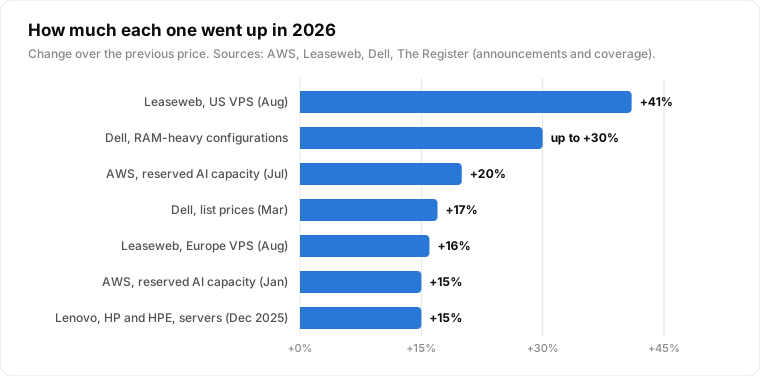
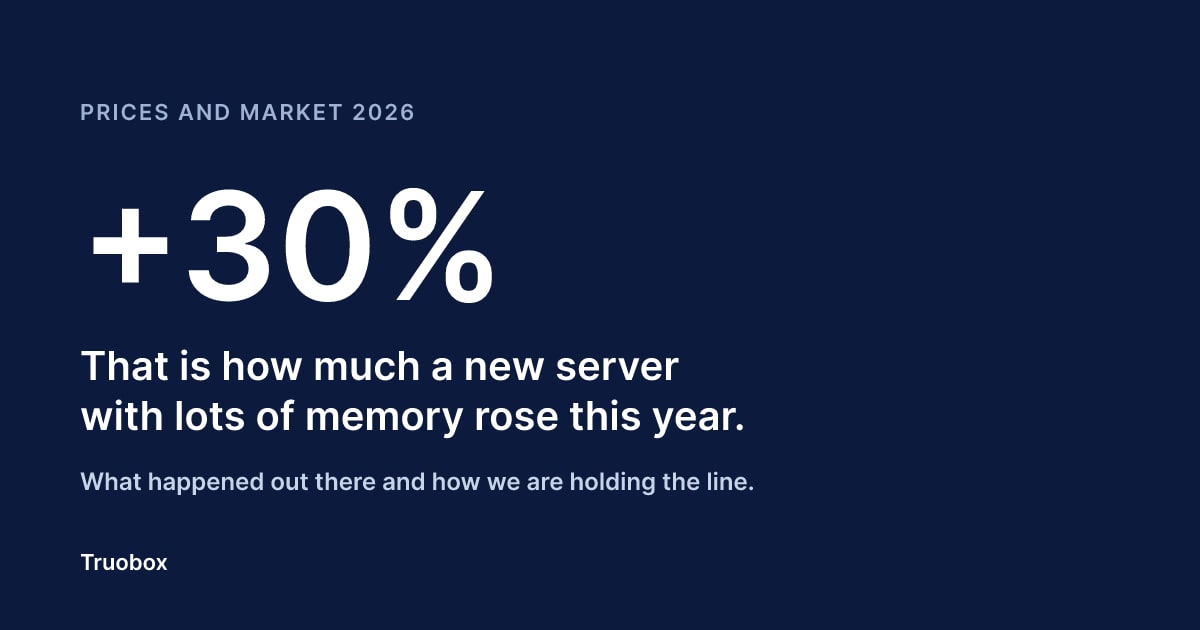
The visible result: buying a new server today costs 15% to 30% more than a year ago, and whoever bought at the new price is already passing it on to their list.
4. How we are holding the line
Our published prices today are the same we had before the increase started. We do not know how long we will be able to hold them; what we do know is that today they still stand:
| Plan | vCPU | RAM | NVMe | Monthly | Paid annually |
|---|---|---|---|---|---|
| VPS Pro S | 2 | 4 GB | 60 GB | $5.95/mo | $4.95/mo |
| VPS Pro M | 4 | 8 GB | 120 GB | $7.95/mo | $6.95/mo |
| VPS Dedi S | 2 dedicated | 8 GB | 120 GB | $9.95/mo | $7.95/mo |
The full list is on VPS.
We can hold them because the infrastructure we already operate does not change its cost: the increase hits new hardware. Our decision is to keep the list as long as installed capacity lasts, instead of buying servers at today's prices and passing that on to you.
That has one consequence you will notice from time to time: when a plan uses up installed capacity, the page shows it as "delayed setup" or "unavailable" until we restock. If the plan you want is in that state, the "Notify me" button writes to you when it is back.
5. If we had to adjust
An adjustment does not reach cycles already paid. A one-year, two-year or three-year plan contracted today keeps its price until the end of that cycle, whatever happens to the list. Monthly plans are billed at the price in force at each renewal, and any change is announced in advance by email. If you want to lock in today's price, the long cycle is the way to do it.
Sources
- TrendForce, 1 jun 2026: Rapid Contract Price Surge Drives 1Q26 DRAM Industry Up 81% QoQ
- TrendForce, 9 jul 2026: Server DRAM Contract Prices Expected to Rise 13-18% QoQ in 3Q26
- TrendForce, 31 mar 2026: AI Server Demand to Drive Memory Contract Price Increases in 2Q26
- The Register, 4 dic 2025: Server prices set to jump 15% as memory costs spike (Dell, Lenovo, HP, HPE)
- Servnet UK, 2026: Server Prices 2026: How Memory Repriced the Rack (Dell +17%, hasta +30%; memoria 18% a 53% del costo)
- Channel Dive: Dell reacts to memory chip crunch as PC, server revenues soar
- TNW, jul 2026: AWS raises GPU prices 20% as the memory crunch bites
- The Register, 30 abr 2026: AWS says server memory shortage pushing customers to cloud
- Leaseweb, 28 jul 2026: VPS price increases are coming for new contracts in 2026 (anuncio oficial)
- Data Storage: The NVMe shortage nobody budgeted for
- 365i, 27 feb 2026: Cloud hosting prices surging up to 50% as AI drains RAM supply